
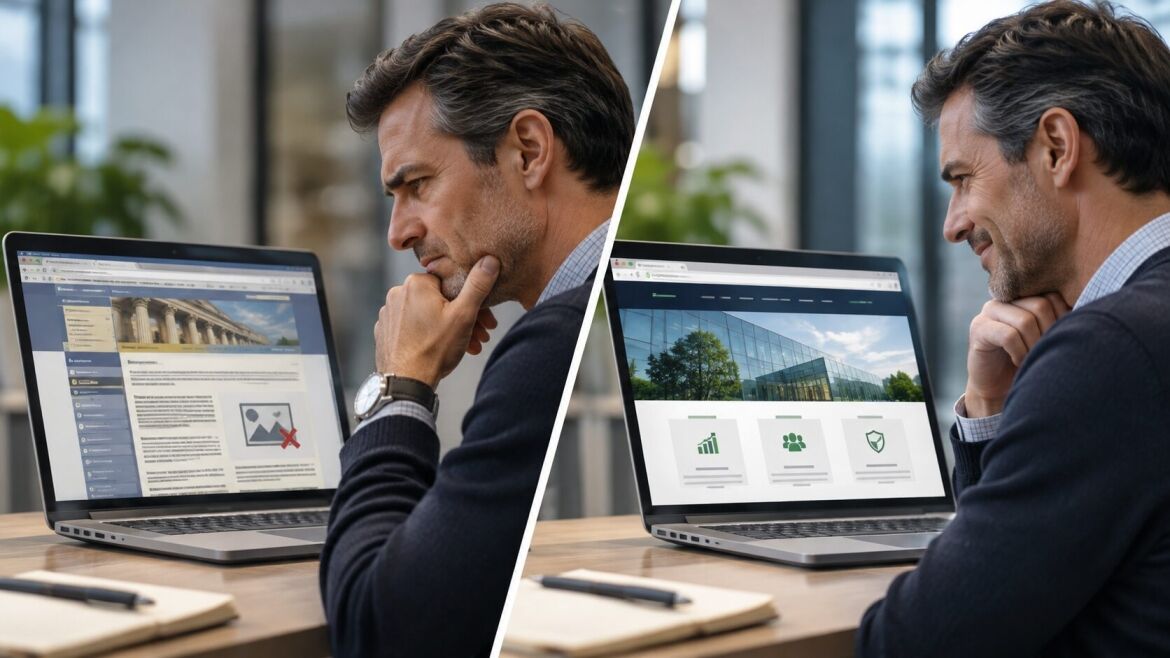
Many businesses treat their website as the last priority, even though it is often the first thing a prospect sees. The article explains how people judge a business within moments of landing on its site, why social media is no replacement, and how sites drift for years because nobody inside the company looks at them.
It also covers how AI tools read and link to websites, the basics a good site needs, and why the business a dated site loses is the business you never see.
“We don’t really use our website.”
We hear this often when we talk to businesses about their websites. And sometimes, they’re right.
They don’t sell anything online. They don’t advertise on Google. Their customers come from referrals, long relationships, and word of mouth. Some have done well for decades without their website bringing in much business at all.
So when the subject of improving the website comes up, the question makes sense. Why spend money on something we barely use?
It’s a fair question. But it misses something important. Just because you don’t use your website doesn’t mean other people aren’t using it to judge your business.
Most businesses treat their website as the last priority. For a lot of the people who find you, it’s the first thing they see. In 2027, with AI changing how people find and research companies, that gap matters more than ever.
Imagine you’re looking for a new accounting firm.
A friend recommends someone they’ve worked with for years. The firm is knowledgeable, responsive, and good at what it does. That’s a strong recommendation.
Before you pick up the phone, you look them up. The website looks like it was built in 2008. It barely works on your phone. The information hasn’t been updated in years.
Does that mean the firm isn’t good? Of course not. But does it make you more confident about hiring them? Probably not.
People form opinions about a business almost as soon as they land on its website. They aren’t reading every page. They’re looking at the design, the layout, and how professional it all feels. Small things count too. If the page doesn’t scroll smoothly or the menu doesn’t work on a phone, people notice right away. Does this business look credible? Does it look established? Does it look like a company I’d want to work with?
Now imagine the same firm has a clean, professional website that clearly explains its services and experience. The recommendation hasn’t changed. The accountants haven’t changed. The quality of their work hasn’t changed. But your impression has.
This matters most for businesses that run on referrals. A referral introduces someone to your business. It doesn’t stop them from doing their own research first. They might glance at your social media too. That tells them you’re active. When they want to know what you actually do and whether you’re established, they go to your website. That’s where the decision gets made.
Think about the businesses you trust most. Their offices are clean. Their signs are in good shape. Their people represent the company well. You notice those details, even if you don’t think about it.
You also notice when they’re missing. A messy lobby or a sign with missing letters doesn’t prove a company does bad work. But it makes you wonder. If they don’t take care of what everyone can see, what are they like with what you can’t see?
Your website sends the same signal. For a lot of prospects, it’s the lobby they walk through before they ever meet you.
Plenty of established businesses have great facilities, experienced people, and decades of success. But their website looks like nobody has touched it in fifteen years.
Consider a manufacturer that’s been on Long Island for 40 years. Over that time, it has bought new equipment, added capabilities, hired talented people, and won major customers. But its website still describes the company as it was when the site went up. Someone researching it today gets an incomplete picture. The business has grown. The website hasn’t.
And it’s not only customers who look. Job candidates check your website before they apply. Vendors and partners check it before they work with you. Existing customers find services they didn’t know you offered.
A good website doesn’t need fancy animations or an expensive design. It needs to look professional, explain the business clearly, and reflect the company you are today.
“It takes 20 years to build a reputation and five minutes to ruin it. If you think about that, you’ll do things differently.”Warren Buffett
You’ve spent decades building your reputation. Your website has seconds to represent it.
Some businesses tell us they don’t need much of a website because they’re active on social media.
Social media is useful. It keeps you visible, shows your culture, and keeps you in touch with people who already know you. But it isn’t built to explain your business.
Posts scroll away. A post from last spring is buried by now. Information about your services ends up spread across dozens of updates. And the platform decides who sees your posts, not you.
Your website is different. You own it. It stays organized. It answers the same questions the same way every time someone visits.
For some businesses, like a restaurant or a retail shop, social media might be the main way customers find them. That’s fine. But for a professional business, social media works best on top of a good website, not instead of one. A prospect might see your post on LinkedIn. Then they visit your website to decide whether you’re worth calling.
Your office might close at 5 PM. Your employees go home. The phones stop ringing.
But someone researching your company at 10 PM can still learn about your services, find your contact information, and decide whether to call you in the morning.
Your website answers the basic questions without anyone picking up a phone. Where are you located? What do you offer? What industries do you work with? How long have you been in business? Who should I contact?
A well-built website can also show up in search results when people look for what you provide, even if you never advertise. You don’t need an aggressive SEO strategy for that to happen. You just need a good website.
A website can look fine on the surface and still have serious problems underneath.
One of the most common problems is also the simplest. Many business websites have no easy way for a visitor to reach out. There’s no contact form, just a phone number buried on one page. Someone who is interested after hours, or who would rather not call, has nowhere to go. So they move on.
We’ve also seen websites where the contact form appears to work, but the messages never reach anyone. A potential customer fills it out and waits. Nobody responds. From their side, your company ignored them. From your side, the inquiry never happened. You might never know you lost it.
The same goes for sites that don’t work on phones, have broken links, load slowly, or list outdated information.
Underneath all of that, websites need upkeep. Outdated software, neglected plugins, and poorly maintained hosting can open security holes that put the site, and sometimes its visitors, at risk.
A website isn’t something you build once and forget. It’s technology, and it needs to be maintained like every other system your business depends on.

Here’s something we notice all the time. Most people inside a company never visit their own website. We’re not immune either. We have about 135 people, and it’s mostly our marketing team looking at ours. Now picture a company with no marketing team at all. Often, nobody is looking.
Why would they? They already know the phone number, the services, and the address. So the website sits untouched. A year goes by, then five, then ten.
Meanwhile, things change. The design starts to look dated. A page lists a service you stopped offering. A form stops working. The site gets slow on phones. Competitors update their websites, and Google can start showing theirs instead of yours.
None of this happens all at once. There’s no alert and no phone call. The website just drifts. And the whole time, the owner assumes it’s still doing its job. In their mind, it’s the website they launched years ago. Everyone else sees the website as it is today.
Think about a car. Park a 2010 model next to the 2027 version of the same model. Backup cameras. Touchscreens. Your phone connects the second you sit down. Safety features that didn’t exist fifteen years ago. Same name on the back, completely different car.
Websites have changed the same way. A site built in 2010 was designed for the screens and expectations of that time. Since then, most browsing moved to phones. Screens now range from small phones to tablets to ultra-wide monitors, and a site has to work on all of them. You don’t want it breaking because the wrong person opened it on the wrong screen. Security standards tightened. Google began favoring sites that load fast and work well on mobile. And now AI tools are reading websites to answer questions about businesses.
If your competitors’ websites have kept up and yours hasn’t, you won’t lose everything overnight. You’ll lose the close calls. The prospect deciding between you and someone else. The referral who looked you up and went with the company that looked more current. One at a time, without ever knowing it happened.
The simplest fix costs nothing. Start with your phone, because that’s where many people will see your website first. Open it and look at it the way a stranger would. Does it load quickly? Can you read it without zooming? Can you find the phone number? Try the contact form. Search for your own services and see whether you show up.
There’s another reason websites matter in 2027, and it barely came up a few years ago.
People used to search Google, click through a few websites, and compare options. Now many of them ask ChatGPT, Google Gemini, or another AI tool to research companies for them. Someone might ask: “Who are some established manufacturers on Long Island that do precision metal fabrication?”
The AI answers with a list of companies and a short description of each. It builds that answer from what it can find: company websites, directories, industry publications, reviews, and other public information.
So if people get answers without visiting websites, does your website still matter? We think it matters more.
Your website is the one place where you control what is said about your business. When it clearly explains what you do, AI tools have accurate information to work with. When it’s outdated or thin, they fill the gaps with whatever else they find.
AI answers also lead back to websites. When a tool like ChatGPT or Gemini shows where its answer came from, the link points to a website. If someone wants to learn more, that link is where they go next. You want it to be yours, and you want it to hold up when they get there.
A few things help:
None of this guarantees you’ll show up in an AI answer. These tools draw on many sources, and they aren’t always right. But Google has said that the same basics that help people, like useful content, clear organization, and good technical performance, still matter for its AI search features.
The technology is changing. The principle isn’t. Make it easy for people, and the tools they use, to understand your business.
Not every business needs an elaborate website. A local manufacturer with a handful of long-time customers doesn’t need the same site as a national retailer. A firm that gets all its work through referrals probably doesn’t need online scheduling or hundreds of landing pages.
The goal isn’t the biggest website possible. It’s a website that fits your business. For most companies, that means getting the basics right:
It also helps to think of a website as an investment, not a cost. Look at what one new customer is worth to your business over a few years. For many companies, a single new account from the website would cover the cost of getting it right many times over.
And you don’t always have to start over. Sometimes improving the website you have is enough.
It’s easy to see the business your website brings in. Someone fills out a form and becomes a customer. You can trace that back.
It’s much harder to see the business that never came. Someone visits your site and decides not to reach out. Maybe it looked outdated. Maybe they couldn’t find what they needed. They won’t call to explain. They’ll just move on.
That’s why websites are so easy to underestimate. You can measure the leads that come through your website. You can’t measure the ones you lost because of it.
Maybe what you have is working right now. Your customers are loyal, referrals keep coming in, and business is steady. That’s great.
But customers don’t stay put forever. A new manager takes over. A company grows and starts reviewing its vendors. Someone sees a competitor that looks more modern and wonders what else is out there.
When your customers start looking for something better, you want to be the obvious answer. Not the company they’re comparing against. Not the one that looks like it stopped paying attention.
The best time to look like the better option is before anyone starts looking.
You’re reading this on our website.
Maybe you found it through Google. Maybe an AI tool pointed you here. Maybe someone shared it with you, or you already knew Flexible IT.
However you got here, you’re now learning something about our company, how we think, and what we believe matters. You might never become a customer. You might not even need an IT provider.
But our website just did exactly what this article describes. It gave you a chance to get to know us.
You never really know who’s visiting your website, what brought them there, or what might come of it.
Your website doesn’t have to be your best salesperson. But it shouldn’t be your worst first impression, either.

