
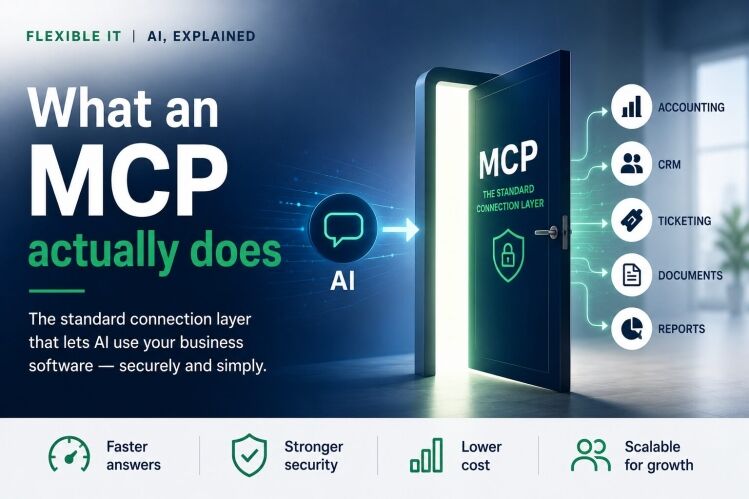
One of the newer terms in conversations about artificial intelligence is MCP. It sounds technical, but the business idea behind it is simple, and it is something leaders should understand as AI moves deeper into daily operations.
MCP stands for Model Context Protocol. Think of it as a common language that lets AI systems communicate with approved business applications and data sources. Your accounting software, CRM, ticketing platform, reporting tools, and document repositories all hold valuable information. MCP gives AI tools a standardized way to interact with those systems, instead of requiring a custom connection for every application.
One point matters from the start: MCP is a connection standard, not a security system. It standardizes how AI talks to your software, but the permissions, identity controls, and governance live in how you implement it. The protocol creates the capability. Thoughtful design creates the safety.
Most businesses are not short on information. They are struggling because that information is scattered across multiple systems.
Your accounting platform holds financial data. Your CRM holds customer and prospect information. Your ticketing system holds service history. Microsoft 365 holds emails, documents, and internal knowledge. Other applications hold operational and industry-specific data.
The challenge is getting answers quickly. You need a report, so you ask someone to pull it. You need a customer update, so a manager checks a system. You need historical information, so you ask the employee who knows where it lives. Sometimes the answer arrives fast, but more often it takes time, and those delays slow meetings, postpone decisions, and consume employee hours.
For years, fixing this required custom development. If you wanted systems to talk to each other or answer new questions, a developer had to build, test, secure, and maintain each integration. Even when the value was obvious, the effort often kept projects from moving forward.
AI is changing how people interact with business software. Instead of navigating dashboards, reports, and spreadsheets, users can increasingly ask questions in plain English.
Imagine walking into your Monday leadership meeting. Instead of contacting your controller for receivables, your sales manager for pipeline, and your service manager for ticket status, you ask:
The AI retrieves approved information from connected systems and presents the answers in seconds. That is a fundamentally different experience than waiting for reports to be generated or data to be gathered by hand.
But AI should not roam freely through your systems. Organizations need a controlled, governed, and secure method for deciding what information AI can access and what actions it can take. That is where a standard like MCP becomes useful.
Without a common standard, every AI connection tends to become its own project, built on custom integrations or vendor-specific connectors. MCP simplifies that by giving AI applications a standardized way to interact with approved tools and systems.
Think of it as a doorway between AI and your business software. The doorway should not be wide open. It should include rules: Who is allowed access? What information can be viewed? What actions can be taken? What stays completely off limits?
When that doorway is built correctly, AI becomes more than a chatbot answering general questions. It becomes a practical tool that helps your team act on information already sitting in your systems. Instead of asking someone to run an aging report, you might ask, “Show me all overdue invoices over $2,500 grouped by client.” Instead of calling a service manager, “Which tickets have waited more than three days for internal action?” Instead of searching a CRM, “Which prospects have not had a follow-up in the last two weeks?” The value comes from combining AI with your business context.

Most Long Island businesses are not lacking technology. They already run accounting software, Microsoft 365, CRM systems, cloud storage, reporting platforms, and industry-specific applications. The problem is that information stays trapped inside those systems. We see it across both counties we serve, from Nassau County professional firms to Suffolk County manufacturers.
If your leadership team still waits for reports, digs through folders, or depends on specific employees to find information, your software is not delivering its full value. AI can make those systems more accessible: a finance leader pulls a receivables summary before a meeting, an operations manager asks which projects are delayed and why, a sales leader spots neglected opportunities. The pattern holds whether you run an accounting firm, a law firm, a medical or dental practice, or a manufacturing operation. The technology is interesting, but the business outcome is what matters. Faster access to information leads to faster, better decisions.
The first question most leaders ask is the right one: “Do I really want AI connected to my business systems?”
The answer is never “connect AI to everything.” It is “connect AI only where it makes sense, with the right controls.” A well-designed integration should answer clear governance questions:
These questions matter far more than the technology. MCP standardizes the connection, but the security comes from proper permissions, strong identity controls, monitoring, and governance. It is the same discipline behind sound cybersecurity and compliance work, applied to a new kind of connection.
It helps to be clear about what MCP does not do. It does not automatically make every application AI-ready. Someone still has to evaluate systems, configure connections, set permissions, test workflows, and verify controls. Some systems are ready today. Some need additional work. Some may not be worth connecting at all.
The goal is not to connect AI to everything. It is to connect AI where it can safely save time, improve visibility, reduce friction, and help people make better decisions. That takes judgment.
MCP matters because it shows where AI is heading. The first wave focused on asking general questions. The next wave is about asking questions about your business, and that is a far bigger opportunity.
The organizations that benefit most will not be the ones using the most AI tools. They will be the ones that understand their processes, know where their information bottlenecks are, and apply AI thoughtfully. Start by asking leadership questions, not technology questions:
The challenge for most businesses is not finding AI tools. It is knowing which systems should be connected, which should not, and how to do it without creating security, compliance, or operational risk.
At Flexible IT, we help Nassau County and Suffolk County businesses evaluate technology through a practical lens. With AI and MCP, that means identifying where AI can create real value, determining which systems are appropriate to connect, establishing security controls, and building governance from the start. It is the same approach we bring to technology planning and IT advisory work every day. The goal is not hype. It is useful, secure AI that works within your business, supports your people, and respects the rules that matter.
MCP is a technical term with a straightforward business meaning: a standardized way for AI systems to communicate with approved business applications and data. Done correctly, it helps organizations access information faster, reduce bottlenecks, and get more value from the software they already own.
But success depends on more than the technology. It takes planning, governance, security, and thoughtful implementation. The opportunity is not simply to use AI. It is to make AI useful, secure, and relevant to how your business actually operates.
If you are exploring where AI could safely create value in your organization, start with the systems you already use. The answers may already be there. The next step is building the right way to access them.
MCP stands for Model Context Protocol. It is a common language that lets AI tools connect to the business systems you already use, like accounting software, a CRM, or a document library, without a custom connection for each one.
MCP is a connection standard, not a security system. Permissions, identity controls, and governance depend on how it is set up. The article explains why business leaders should pay attention now and why the best place to start is with the data you already own.
Explore more insights from our IT experts.


