
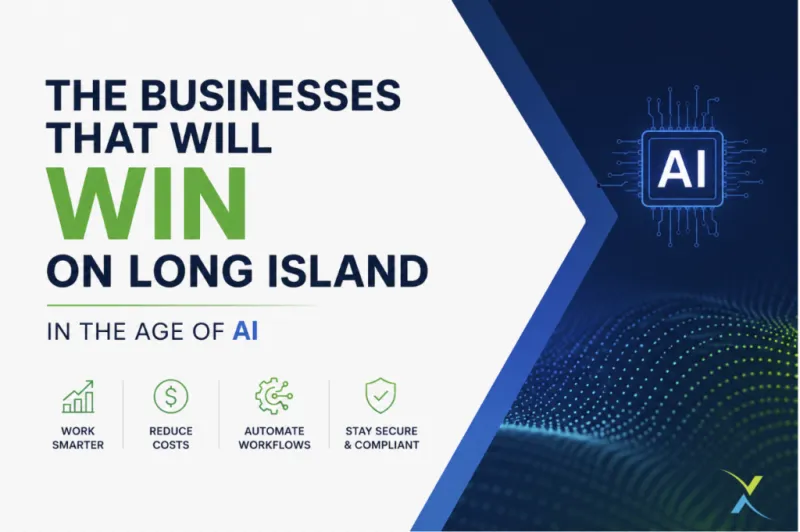
There is a quiet sorting happening across Long Island right now. It is not loud, and it is not dramatic, and most business owners cannot yet see it from where they are standing. But it is real, and it is moving fast.
Two companies in the same industry, on the same street, with the same headcount and the same revenue, are about to look very different in three years. One of them is using AI every day. The other is not. That is the entire game.
The businesses that will win on Long Island in the age of AI are the ones that actually pick up the tools. The ones that do not will fall behind. That is the surface of the argument, and it is true. But the deeper point is more interesting, and worth paying attention to, because it changes how you should think about who you hire, who you pay, and what your business actually needs.
For as long as Long Island has had a business community, the rule has been the same. If you need something done well, you either do it yourself, or you hire a specialist. You hire a marketing agency for marketing. You hire an SEO firm for search. You hire a copywriter for your blog. You hire a web designer for your site. You hire a CPA for your taxes. You hire a financial advisor for your investments. You pay for credentials, experience, and access to knowledge you do not have.
That logic is breaking. Not because expertise has stopped mattering, but because the gap between an expert and a smart, motivated generalist has shrunk dramatically. A business owner who knows their company inside and out, who is willing to spend a few hours learning how to use AI tools properly, can now produce marketing copy that competes with an agency. They can publish blog content that ranks. They can draft contracts that hold up. They can run financial analysis that used to require a consultant. They can model scenarios, write code, build dashboards, and answer questions about their own data that they could not have answered six months ago.
This is not theoretical. It is happening in accounting, where small business owners are using AI to prepare cleaner books than the bookkeeper they were paying. It is happening in tax prep, where smart owners are catching deductions and structuring decisions that used to be the value-add of the CPA relationship. It is happening in finance and investing, where regular people with AI tools are running analysis that rivals what was once locked behind a brokerage account. It is happening in law, in HR, in operations, in customer support. Every knowledge field where the value was “I know more than you do” is being squeezed.
The expert is not dead. There are still places where credentials, fiduciary responsibility, and judgment under uncertainty matter, and those people are not going anywhere. But the days of paying premium rates for work that AI can now help you do in-house, with a fraction of the time and money, are ending. The smart generalist with AI is the new competitor. Not just to other businesses, but to the entire economy of outsourced expertise that Long Island businesses have relied on for decades.

Imagine two construction companies on Long Island. Same size, same crews, same market. One owner spends thirty minutes every morning using AI to write proposals, respond to RFPs, draft contracts, generate marketing copy for social, summarize project notes, and pull together the weekly numbers. The other owner is still doing what they have always done. Calling the marketing agency for the website refresh. Paying the bookkeeper to clean up QuickBooks. Hiring a copywriter for the blog. Waiting two weeks for a proposal that they could have written themselves in an afternoon.
At the end of the year, the first business has produced more output, responded faster, won more bids, published more content, and spent less money doing it. The second business has been billed for all of that work by outside vendors, paid premium rates, and waited their turn in the queue. Multiply that across three years and the gap is no longer a gap. It is a different business.
This is why the businesses that win will not always be the biggest. They will be the most adaptive. The owner with a curious mind and ninety minutes a week to learn a new tool is going to outcompete the owner with the bigger team and the bigger budget who refuses to look at the screen.
The numbers behind this are starting to show up in the research. A 2025 benchmark of 403 firms tracked by SPI Research found that the most AI-mature organizations grow revenue 7.4 times faster than the least mature, earn profit margins more than six times higher, and improve workforce utilization by 71 percent. The gap is not subtle. It is the difference between the company that keeps growing and the company that quietly slips behind.
Here is the part that gets misunderstood. If AI is collapsing the expertise economy, what about your IT partner? Should that go too?
No. The opposite. Your technology partner becomes more important, not less.
Here is why. AI is a tool, and like every tool that has come before it, the people who get the most out of it are the ones who know how to set it up, how to use it safely, and how to integrate it into the rest of their business. The owner using ChatGPT for an hour a day is producing real value. But that same owner is also pasting customer data into a chat window without thinking about where that data goes. They are running tools they do not understand on networks that are not configured for them. They are picking AI products based on a YouTube video and a price tag, not because they fit the business. They are missing the security layer, the compliance layer, the integration layer, the training layer, and the strategic layer that turns a useful tool into a real competitive advantage.
That is the work. Picking the right tools out of a thousand. Setting them up so they actually help. Configuring them so customer data does not leak. Training the team so they use them well. Building the workflow so the work compounds. Knowing what to ignore. Knowing what to wait on. Knowing what is real and what is hype. None of that is something AI does for you. All of it requires a partner who lives and breathes the technology, who watches the landscape every day, and who knows your business well enough to give you a real answer. That is the shift from traditional managed services to managed intelligence, and it is the whole point of what a modern technology partner actually does.
This is the role we have built Flexible IT around. We are not the marketing agency you are about to replace with a smart prompt. We are the partner you keep. Effortless IT exists because the businesses that win in the age of AI are going to need fewer outsourced specialists, not more, but the ones they keep are going to matter more than ever. The technology partner is one of them. Possibly the most important one.
If you take one thing from this, take this. The cost of starting is zero. The cost of staying in is about what a Chipotle bowl costs. A premium AI subscription runs roughly the same per year as a few lunches out. That is the price of access to a tool that is reshaping every industry it touches. The cost of waiting another year, on the other hand, is high and getting higher.
Pick one repetitive task in your business this week. It does not have to be glamorous. Maybe it is the weekly email to your team. Maybe it is the standard proposal template you send to every new client. Maybe it is the monthly report that takes you four hours to put together. Open ChatGPT, or Claude, or whichever tool your business has access to, and try doing that task with AI for thirty days. Just make sure you are doing it within a sensible AI policy so customer data and sensitive business information stay where they belong. Measure how much time you save. Pay attention to what works and what does not.
Then do it again with another task. And another. That is how this happens. Not by replacing your business overnight. By compounding small wins until the way you work is fundamentally different from the company down the road that is still doing it the old way.
Very shortly, you will realize that tasks that used to take days or weeks now take minutes or hours. The proposal you used to dread on Friday afternoon. The quarterly report that ate up most of a week. The new employee handbook you kept pushing to next month. The website copy refresh you put off for a year. These things compress. Once you see it for yourself, you cannot unsee it, and you start looking at every part of your business through the same lens.
If you want help figuring out which tools to use, how to set them up safely, and how to make them work for the specific shape of your business, that is what we do. The IT Advisory part of Effortless IT exists for exactly this reason. We are not selling you AI. We are helping you use it well.
Before you can build a plan, you need to know where you are. We put together a short assessment called the AI Maturity Curve. It takes about two minutes. Twelve questions across five capability pillars. At the end, it tells you which of the five stages of AI maturity your business is currently sitting in, from ad-hoc usage at one end to fully integrated and optimized at the other. Most Long Island businesses are still in the first two stages, whether they realize it or not. The assessment will tell you which one, and what moving up the curve actually looks like.
If nothing else, take the two minutes. It is the cheapest way to find out whether you are ahead, behind, or somewhere in the middle. And the gap between stages, based on the research, is the difference between growing 7.4 times faster than your competitor or watching them grow 7.4 times faster than you.
The Long Island businesses that will win in the age of AI are not the ones with the biggest expert teams or the deepest pockets. They are the ones whose people learn to use AI well, who replace expensive outsourced work with smart in-house work, and who keep the technology partner that helps them do it safely and at scale.
The expertise economy is shifting under our feet. The companies that see it will move. The companies that do not will look up in three years and wonder how the shop down the road got so far ahead.
Pick up the tools. Find the right partner. Take the assessment. Start this week.
A quiet sorting is happening across Long Island. Two similar companies on the same street will look very different in three years, depending on whether they use AI every day.
The deeper shift is that the expertise gap is collapsing. AI lets businesses do work that used to require hiring specialists. That changes who you pay and what you need from a technology partner, which is to help you use these tools safely and at scale.
Explore more insights from our IT experts.


