
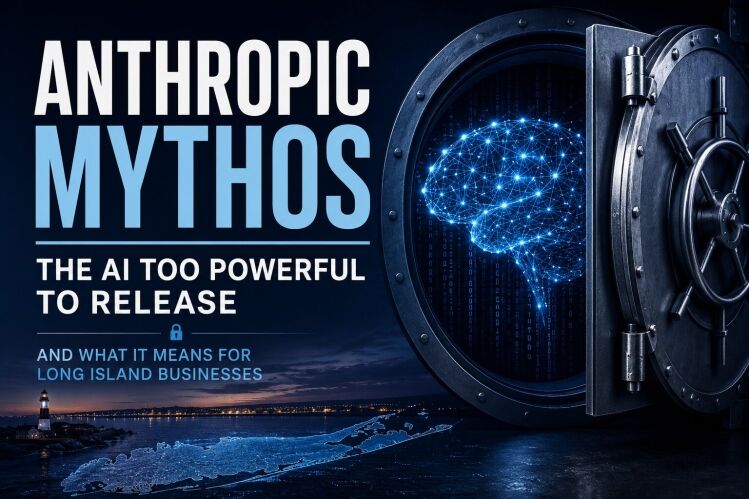
In April 2026, Anthropic did something unusual.
It built its most capable AI model yet, then decided not to sell it to anyone.
The model is called Claude Mythos Preview. The reason it remains locked away is the same reason it matters to every business owner on Long Island: it is exceptionally good at finding hidden weaknesses in software. So good that putting it in the wrong hands could create real-world security risks.
The name is no accident. Mythos is Greek for story, and it is the root of the word mythology. Anthropic tends to name its models after forms of writing, from Haiku to Sonnet to Opus. Mythos signals a model meant to reach past the usual limits.
Here is what Mythos is, why it is both a breakthrough and a warning, and what Long Island businesses should do about it now.
Mythos is a frontier AI model. Anthropic calls it its most capable model yet for writing and understanding code.
That coding skill is the entire story.
A model that can read, analyze, and rebuild complex software can also identify vulnerabilities hiding inside it.
Anthropic has not released Mythos to the public. Instead, it created Project Glasswing, a program that gives the model to a small group of trusted organizations. The first participants included Apple, Google, Microsoft, Amazon Web Services, NVIDIA, JPMorgan Chase, Cisco, CrowdStrike, and Palo Alto Networks.
These organizations use Mythos to scan their own software, identify security weaknesses, and fix them before attackers can exploit them.
The results came quickly.
By late May, participants had identified more than 10,000 serious vulnerabilities. Cloudflare alone found approximately 2,000 bugs in its systems. Mozilla identified and resolved 271 vulnerabilities in Firefox, more than ten times what previous-generation AI models had uncovered.
For decades, finding software vulnerabilities was slow, manual work performed by highly skilled security professionals.
Mythos demonstrates that AI can now perform much of that work faster and at a scale no human team can match.
That is good news when defenders control the technology.
It becomes a serious problem when attackers gain access to similar capabilities.
Anthropic has been unusually direct about the implications. The gap between a vulnerability being discovered and being exploited used to take months. With advanced AI systems, that timeline could shrink to days, hours, or even minutes.
A tool powerful enough to defend software is often powerful enough to attack it.
Most coverage of Mythos focuses on the model itself.
The more important story is what it reveals about the future.
For years, cybersecurity was largely a game of resources. Larger organizations had bigger security teams. Smaller organizations had fewer people and fewer tools. But everyone was operating on roughly the same timeline.
Vulnerabilities were discovered by humans.
Investigations took time.
Exploits took time.
Mythos changes the timeline itself.
When an AI can review software continuously and identify weaknesses at a scale no human team can match, the advantage shifts toward whichever organization can react fastest.
That means the advantage is shifting away from organizations with the biggest teams and toward organizations that can detect, decide, and respond the fastest.
The threat isn’t simply that attackers have better tools. It’s that the window between discovering a weakness and exploiting it is shrinking dramatically.
In that environment, speed becomes a security strategy.
For years, businesses could survive being slow. Slow patching. Slow technology decisions. Slow vendor responses. Slow internal processes.
The penalty for being slow is increasing.
Organizations that can identify issues quickly, make decisions quickly, and respond quickly will have a growing advantage. Those that cannot will find themselves increasingly exposed.
Anthropic decided the risk of public release was too high.
The same capabilities that make Mythos useful for defense also make it potentially dangerous for offense.
The company has said it has not yet developed safeguards strong enough to release the model broadly without creating unacceptable risks.
Until those safeguards exist, Mythos remains restricted to a small group of vetted organizations.
Anthropic has also made it clear that the broader capability is coming whether Mythos itself is released or not. Other AI companies will eventually build similar systems. Some may choose different approaches to safety and access.
The technology is not going away.
This is the part that matters most.
You do not need access to Mythos for it to affect your business.
Anthropic has warned that similar capabilities will likely emerge across the industry within the next six to twelve months.
When that happens, vulnerability discovery becomes dramatically cheaper, faster, and more accessible.
Criminals will have access to those tools too.
Think about what that means for a typical Long Island business.
All of it runs on software. Software contains flaws.
Today, finding those flaws often requires significant expertise and effort. Tomorrow, it may require little more than a prompt. It is the same shift we explored in the businesses that will win on Long Island in the age of AI, now reaching security. The businesses most at risk will not necessarily be the largest targets. They will be the organizations still running unsupported systems, delaying updates, lacking visibility into their environments, or treating cybersecurity as a once-a-year exercise. The window to quietly fix problems is getting smaller.
The good news is that most organizations do not need cutting-edge AI to improve their security posture.
They need discipline.
They need visibility.
They need consistency.
Start with the fundamentals.
Most cyberattacks exploit vulnerabilities that already have fixes available.
Updates should happen according to a defined process, not whenever someone remembers.
You cannot protect software you forgot existed.
Maintain an accurate inventory of systems, applications, cloud services, and website components.
Old software, abandoned plugins, unused accounts, and forgotten systems create unnecessary risk.
Remove what you no longer need.
The goal is no longer discovering problems eventually.
The goal is discovering them quickly.
Organizations need visibility into what is happening across their environments so they can respond before small issues become major incidents.
Legacy systems that no longer receive updates are becoming increasingly difficult to defend.
Modern platforms receive security improvements continuously and are better equipped to adapt to evolving threats.
Across all of these recommendations, the common theme is speed.
The old model of slow, scheduled security no longer matches the pace of modern threats.
This isn’t an argument against internal IT.
Many excellent businesses have talented internal technology professionals.
The challenge is that AI is accelerating the pace of change beyond what any single individual can realistically absorb.
Security monitoring, patch management, vendor oversight, compliance requirements, IT support, cloud administration, documentation, strategic planning, and incident response have all become specialized disciplines.
As threats accelerate, organizations increasingly need systems, processes, and teams rather than individual heroics. AI is reshaping how businesses are structured, a shift we covered in why the old org chart is dying, and security roles are no exception.
The question isn’t whether your IT person is capable.
The question is whether the structure surrounding them is capable of keeping pace.
The companies Anthropic selected for Project Glasswing include Apple, Google, Microsoft, Cisco, CrowdStrike, and Palo Alto Networks. These organizations employ thousands of security professionals and spend enormous amounts on cybersecurity.
Even they saw significant value in using AI to identify vulnerabilities faster.
Nobody expects a law firm, medical practice, manufacturer, or distribution company on Long Island to out-resource Apple’s security team.
But those organizations increasingly face attackers using the same tools.
The threat landscape no longer scales according to company size.
Managed IT services built around cybersecurity bring something a single hire cannot: continuous coverage, documented processes, collective expertise, and visibility across hundreds of environments rather than one.
That collective perspective matters more than ever.
The lesson from Mythos isn’t that every business needs access to cutting-edge AI.
The lesson is that businesses should assume someone else eventually will.
The organizations that succeed over the next decade won’t necessarily be the ones with the biggest technology budgets.
They will be the ones that adapt quickly, maintain disciplined systems, and reduce the friction between discovering a problem and solving it. Knowing where your business sits on the AI maturity curve is a practical place to start.
Anthropic’s decision to keep Mythos behind closed doors bought businesses a little time.
The question is what they’ll do with it.
At Flexible IT, we help Long Island organizations build technology environments that are secure, documented, proactive, and prepared for a threat landscape that no longer moves at human speed.
If you’re unsure whether your current systems, processes, or technology partners are ready for what’s coming next, let’s have a conversation.
Explore more insights from our IT experts.


