
Every vendor you work with is selling AI right now.
Your marketing agency is selling AI. Your web developer is selling AI. Your insurance broker probably mentioned it on the last renewal call. The pitch has become standard: we will connect AI to your business systems, analyze your customer data, surface trends, uncover opportunities, and answer questions about your own business information.
There is a reason the pitches sound identical. Saying you do something with AI is the fastest way to win a meeting right now. It costs nothing to say, so plenty of firms added it to the pitch well before they added it to the business.
If you run a small or midsize business on Long Island, you have probably heard some version of that pitch more than once this year.
It sounds impressive in a conference room. It should also make you stop and ask a simple question.
Who is actually qualified to do that?
Read those promises again. Connecting to business systems. Accessing customer data. Analyzing sales information. Integrating across platforms.
Every one of those is an infrastructure task. It requires access controls, data governance, identity management, secure integration, monitoring, and a real understanding of where your sensitive information lives and who is allowed to touch it.
That is not a content problem. It is not a branding problem. It is a technology problem.
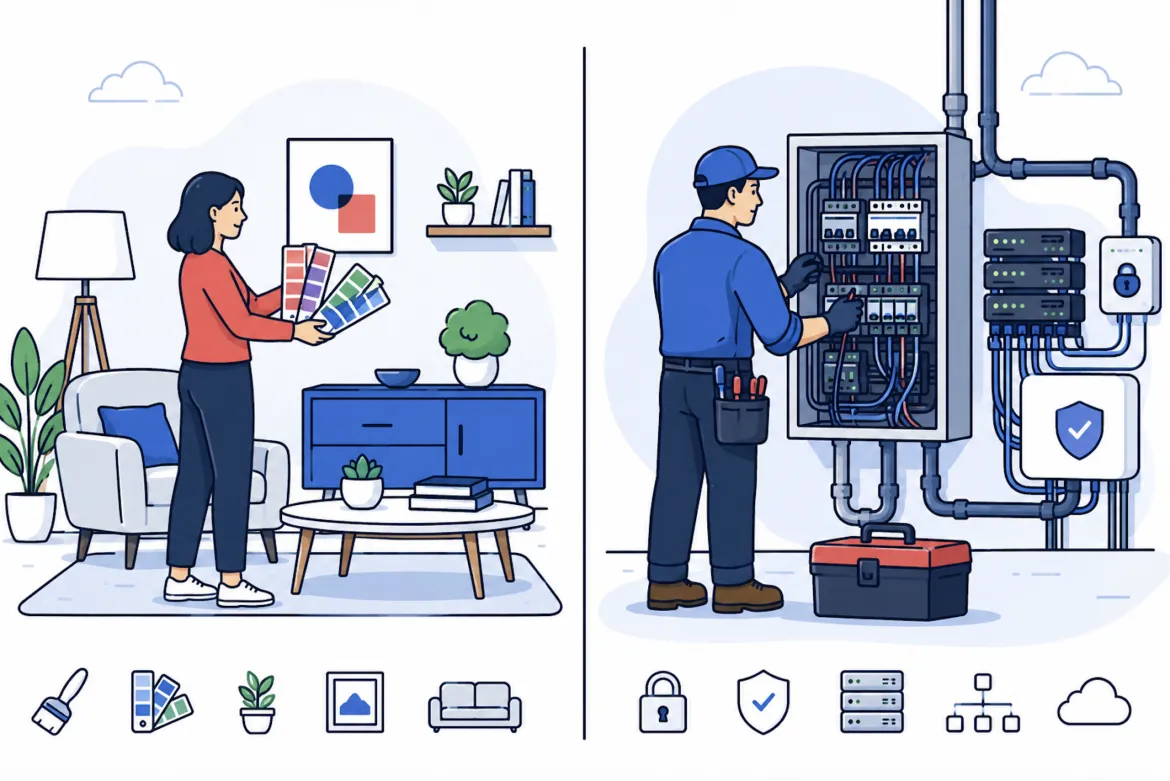
The dividing line is not marketing versus IT. It is whether the vendor making the recommendation is responsible for the environment the AI will touch. Plenty of firms do excellent work in their lane. Content strategy, video, design, campaign management, web development. Using AI to accelerate that work makes sense, and the good ones are already getting real results with it.
But there is a wide gap between using AI to produce a landing page and wiring AI into the systems that run your company. The first is a creative decision. The second is an access decision. Different question, different qualifications.
If you want to understand what "connecting AI to your systems" actually means under the hood, we wrote a plain English explanation of MCP, the standard most of these integrations now use.
We have written before about the upside down pyramid of AI. Businesses build sophisticated capabilities on top of weak foundations, then wonder why everything collapses.
AI is the fastest way to build an upside down pyramid we have ever seen.
Give an unvetted AI tool access to your CRM and your file server and you have created a data exposure problem, a compliance problem, and an audit problem in a single afternoon. Most businesses will not discover it until something goes wrong. By then the data has already moved.
That last question matters more than most people expect. Most Long Island small businesses touch at least one of these frameworks, often without realizing how many. If your business touches HIPAA, PCI DSS, the FTC Safeguards Rule, NYDFS Part 500, or a SOC 2 report your own clients rely on, an AI tool with unmanaged access to sensitive data is not a productivity experiment. It is an unreviewed change to your control environment.
Here is the mechanism, and it is the same across almost every framework. They all require you to control access to sensitive data, and they all require you to oversee the third parties who handle it. Connecting an AI tool to your systems does two things at once. It creates a new path to your data, and it adds a new party processing that data. If neither one went through review, you now have a control gap that predates any breach. You are out of step with your own written program, which is what an auditor tests against.
These are the frameworks we work in every day, and increasingly the reason governance and risk work cannot live in a spreadsheet anymore.
The answers tell you everything. So does how long it takes to get them.
Flexible IT has been supporting Long Island businesses since 1984. We have guided clients through every major shift in that time. Client server. The internet. Virtualization. Cloud migration. Mobile. Modern cybersecurity. Compliance frameworks.
The pattern repeats. A new technology arrives. A wave of vendors appears claiming expertise they do not have. Businesses that move fast without a foundation get hurt. Businesses that move deliberately with a partner who knows their environment come out ahead.
We know your systems because we built and maintain them. We know your data because we protect it. We know your risk profile because we assess it. That context is not optional when you are deciding what AI should be allowed to see.
We are moving into AI carefully and on purpose. Careful is not the same as idle.
We run AI inside our own business first. Our team uses it in daily operations, on our own systems, with our own data at stake, before we put a recommendation in front of a client. We hold ourselves to the standard we would hold any vendor to.
Flexible IT is SOC 2 Type II attested, and we partner with Vanta for continuous compliance monitoring. That matters here for one specific reason. Our own access management and vendor review practices have been independently tested over a period of time, not just described in a document. So when an AI tool comes across our desk, we are applying a review process we have already been held to by an auditor.
We also help Long Island small businesses get started, and that work is less glamorous than the sales pitch you have been hearing. Where does your sensitive data actually live. Who has access to it today. Which AI tools are already inside your environment because an employee signed up for one on a corporate credit card. What can be turned on safely this quarter, and what should wait.
That is also where the real upside is. AI collapses the time between idea and done, and the businesses that compound that advantage are the ones whose foundation can carry it.
We test before we deploy. We evaluate security posture before we recommend a tool. We think through what happens when something fails, not just what happens when it works. We are not in a hurry to be first, because being first with the wrong implementation is worse than being second with the right one.
AI is powerful. That is exactly why it deserves caution. Anyone treating it as a quick add on to an existing service line is telling you how little they understand about what they are selling.

The tortoise did not win by resting. He won by never stopping. Slow and steady still wins.
Before you sign anything, ask yourself who you would call if an AI tool exposed your client data tomorrow.
If the answer is your IT partner, then your IT partner should be involved in the decision from the beginning.
That is the whole argument.
If you are not certain what an AI tool could reach inside your business today, that is worth knowing before anyone connects one. Tell us what you are running and what you are being pitched, and we will walk through it with you.


